Bridesmaids, Popcorn and Babies

Now here is something that didn’t exist when I was home with babies –  Stars and Strollers, the afternoon matinees just for parents ( and grandmas, and eager aunties, and friends) and – get this – babies.  My daughter,  Zoe, and my oh so adorable one-year-old granddaughter came to visit and we decided we had to give this a try.   We picked a movie that we really wanted to see (maybe that was a mistake), which unfortunately was only playing way, way across the city (perhaps our second boo-boo) and headed off to meet a friend of Zoe’s and her one-year-old little guy, and to observe the darling chaos of it all.

The movie was Bridesmaids and for a Wednesday afternoon there appeared to be a pretty big turn out of mostly new mommies and teeny weeny babies. I noticed a few grandmothers in the crowd, amongst the stroller pushers.  My youngest daughter, Lily, wanted to see the movie, but not as much as she wanted to hang with her out-of-town tiny niece at the theater, so she was with our group, as well.

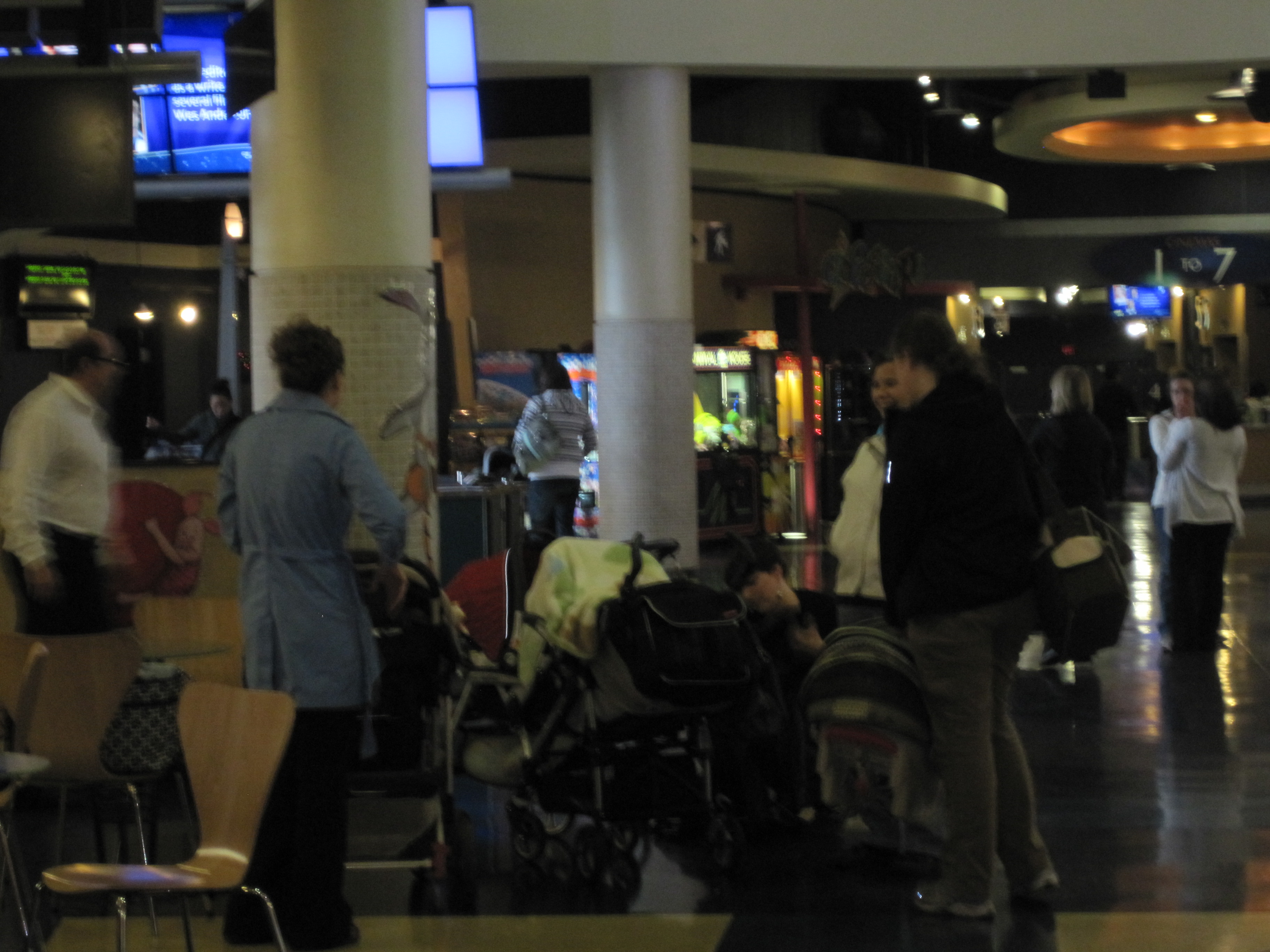
The lobby was a stroller-a-thon though the  two women purchasing tickets ahead of me were being charged regular price for not having a under two-year-old with them (which is what the fine print on the Cineplex web site says would happen), but they successfully argued they should be entitled to the same discount the rest of us were getting for the inconvenience of being surrounded by all those babies.  Now I have to say right off, if they really came to enjoy the movie, the constant interruption wasn’t worth the discount, but if they came to take in the sight of forty plus moms trying to take pleasure in a movie while nursing and changing and soothing and bouncing forty plus babies – now that was worth the price of admission.

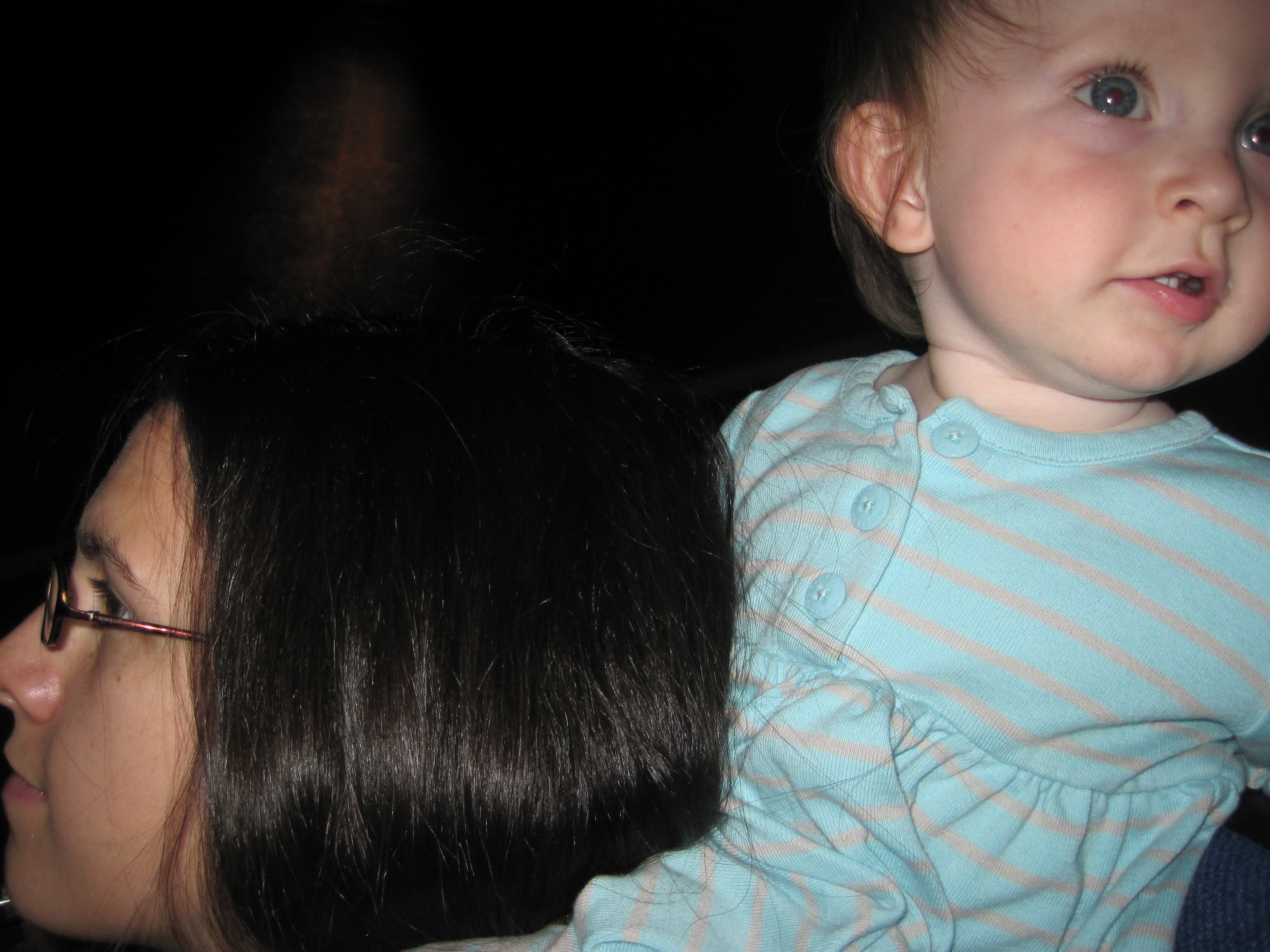
Our driving across town had given grand-baby the chance for a solid nap so after a short period of calmly taking in the dimly lit room full of her baby peers, and then staring at the larger than life characters of Annie and Lillian on screen,  she was ready to sit on mommy’s head, or travel from mommy’s lap to grandma’s lap to auntie’s lap and back again, while experiencing the new sensation of being fed little iddy bits of popcorn. None of the babies cried for very long, rather they all took turns at crying for short periods of time.  Zoe and her friend were critical of the character development in the zany comedy, but who the hec knows how they could have possibly have followed the plot lines while keeping their babies entertained – though they and their movie going peers were all learning to be the mothers-of-all multi-taskers.

I figured twenty-one-year-old Lily would say that sitting amongst a roomful of wah-wah-wah-ing babies was a stupid way to watch a flick, but she loved her niece’s visiting her seat-side to press crumbs of sticky popcorn into her mouth, and insisted she was able to tune out the babies bawling over top of  clever lines such as the bride, Lillian, asking her messed-up bridesmaid, Annie, “Why can’t you be happy for me and then go home and talk about me behind my back like a normal person?”

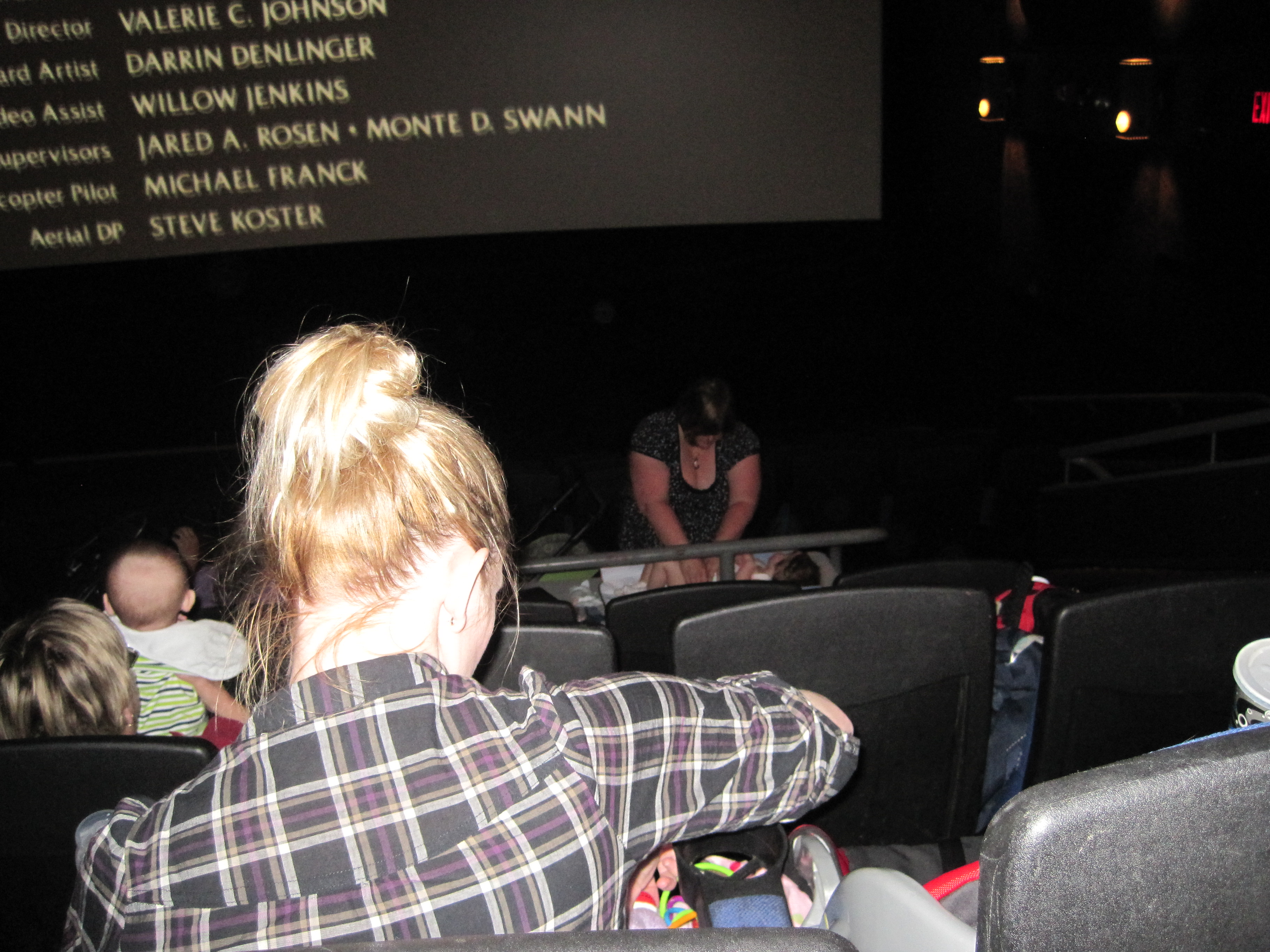
At the  front of the theater was a changing table, a slightly lit-up spot where you would not miss a second of the soundtrack, but the audience had a clear view of you tending to your infants soiled diaper needs.  We noticed only one man in the entire theatre, and when he was the one to come stand in that light and expertly change his baby, I know most the moms were watching this macho figure in his baseball cap rather than Kristen Wiig and Maya Rudolph and wondering if their own baby-daddy would be so bold?

Stars and Strollers was an event, a gathering, shared camaraderie amongst a group of pretty new moms, allowing themselves – despite the squawking and wiggling of their infants – a  bit of entertainment on a weekday afternoon.  But I think I’ll go see Bridesmaids again – because I don’t feel like I’ve seen it yet.

Chill Out, Mommy. Chill Out.

Gatwick South Terminal international arrivals ...

Image via Wikipedia

March 31st, 200_

Our youngest daughter was once again about to leave home, city, country, continent.  Continent!!! To go traveling around Europe for two months.  (It gets scarier.)  She was just eighteen and had never even considered going with someone.  In less than twenty-four hours she would fly to London, England and then to meet Canadian friends already in Barcelona.  She was trying to calm the parental unit.  Rest assured, was her message, as we pictured her enveloped by a group of large Canadian seasoned travelers whose sole purpose was to take care of her.  We tried not to think that they might be a bunch of scrawny yahoos, who may or may not give a rat’s ass about her safety.

She would be traveling on her own from Calgary to London, Heathrow, then to Gatwick, from there to Reus airport at which point she would take a bus into Barcelona – a foreign city of more than a million and a half people.  And then, she said, as if this was the easiest part of the equation, I just have to get to Café Zurich and my friend, Teddy, will be there waiting.

So we are supposed to find some comfort in this guy being there, in the dark (she arrives late at night) in the café in Spain.  I wish he had a different picture on Facebook.  He is two years older than her, but the only image I’d seen of him was the one he used for his facebook photo from when he was a gapped-toothed five-year-old.

While I contemplated my anxieties around this – she should have been in the house finalizing her packing, making sure her papers were in order – passport and medical insurance forms, maps and directions, youth hostel and Eurail pass.  But she wasn’t.  She was`out with friends, saying her good-byes before her two month adventure.

Her dad and I both confessed to each other of being jealous of how much freedom she’d have in the next little while, but right then we didn’t want to think about that freedom or her being able to follow the whim of the day.  We wanted to know where she would go and exactly when – maybe even why.  Of course, our need to track her movements was part of what she was supposed to be getting away from by traveling around Europe.

She had attempted to comfort us by saying that after Barcelona she would go meet a cousin and his girlfriend in Amsterdam, who were already off on their own backpacking experience.

I’ve been to Amsterdam myself on the backpacking trip I took with a girlfriend after we graduated high school thirty some years ago.  I rememberhow after we left the train my girlfriend and I were offered coke, LSD and pot from various guys sitting on the station steps in the Netherland sunshine.  When I had left my parents at the Calgary airport I understood them to be happy, even excited, to see me off. They had informed me years later that they were scared out of their minds.  I know I sent them a few letters but that was all they heard from me for the ninety days that I was away from home.

I expected to get fairly frequent emails from Lily, but still on the afternoon before her trip, I was incredibly anxious, because any way you cut it –with all the technological advances and far reaching communication, it was still a big wide world, with millions of people who would be blocking the path between us.  I managed to take her out for a few last minute purchases and afterward we shared a quick meal together in a pub, where I delivered a few more safety lectures in between bites of quesadilla before I brought her home to pack.  I had barely time to say, oh yeah watch out for blah, blah, blah when she was out the door again.

Her final laundry and packing, and my putting a dozen items in teeny zip lock bags happened well past midnight.  What was driving me crazy was that I simply couldn’t figure out why, instead of preparing for this huge trip, my usually organized daughter was devoting way too much time to hanging out with friends and staying out late somewhere else – downloading music for her trip onto her ipod.  I think if I were to ever see my children pack ahead of time I might feel confident that they were preparing like adults.  I would take some comfort in their setting priorities and putting details in order.   Maybe I would even decide that in their time away from me they would continue to behave maturely, taking care of what needed to be done, not fall to the evils of wild and impulsive poorly planned acts.

April 1, 200_

So it was April.  The first.  No April fools jokes had been played.  My baby was flying to London, England alone.  It wasn’t until I woke her to get up and head to the airport that she said, “Oh my God Mom, I’m leaving for two months and I don’t know if I have what I need.”  I swallowed all the lectures, assured her that she had, and if not, the last time I checked there were stores in Europe, and then her dad and I looked on while she tried to get her top heavy pack on her thin frame.  She thought about taking out the heels a girlfriend had advised her to bring the night before.  No, no, I said.  You’re a heels girl.  You’ll get to Europe, look around at all those beautiful women in their beautiful heels, and want yours.

In no time we were rushing out the door, her cell phone purposefully left behind on the kitchen counter, a link broken.  Her first task after customs in London would be to find her way to a shuttle to take her to Gatwick, where her second flight would depart to Barcelona.  Landing in Barcelona at ten o’clock at night (after dark, in my world – early evening, in hers) she would have to make her way to Barcelona where she would meet a friend at the Café Zurich in Cataluna Plaza.  She had been online to figure out the shuttle times between the two British airports and I trusted her friend, this guy with the impish photo, had given her directions to the Café Zurich.  Suddenly, on route to the airport, I was certain that I would have assisted my three older kids at the same stage, in finding the correct information before they left home.  Now, I couldn’t figure out what was wrong with me.  What kind of a mother was I?

The one she had made me, I guess.  Nature vs. nurture is a bit of a circular argument.  I may have nurtured my kids to become one sort of person, but nature has created them to be oddly distinct individuals who in turn require an individual type of mothering.

Lily’s older brother, Hudson, came to the airport to keep the mood light and the lectures down to a minimum, though I couldn’t stop myself from pointing out how many times a pickpocket might have grabbed Lily’s possessions as she sat her small open bag here and there, while she checked in and grabbed a Tim Horton‘s chili (at ten am.)

Her brother told her, Don’t let anyone rob you, hurt you or steal you.  I nervously concurred and kissed her seven times and then two more while the young security guard looked impatiently away.  I let her go – my baby, slipping out of my grasp again.  Bon Voyage Lily.  Bon Voyage.

Mr. Tambourine Man

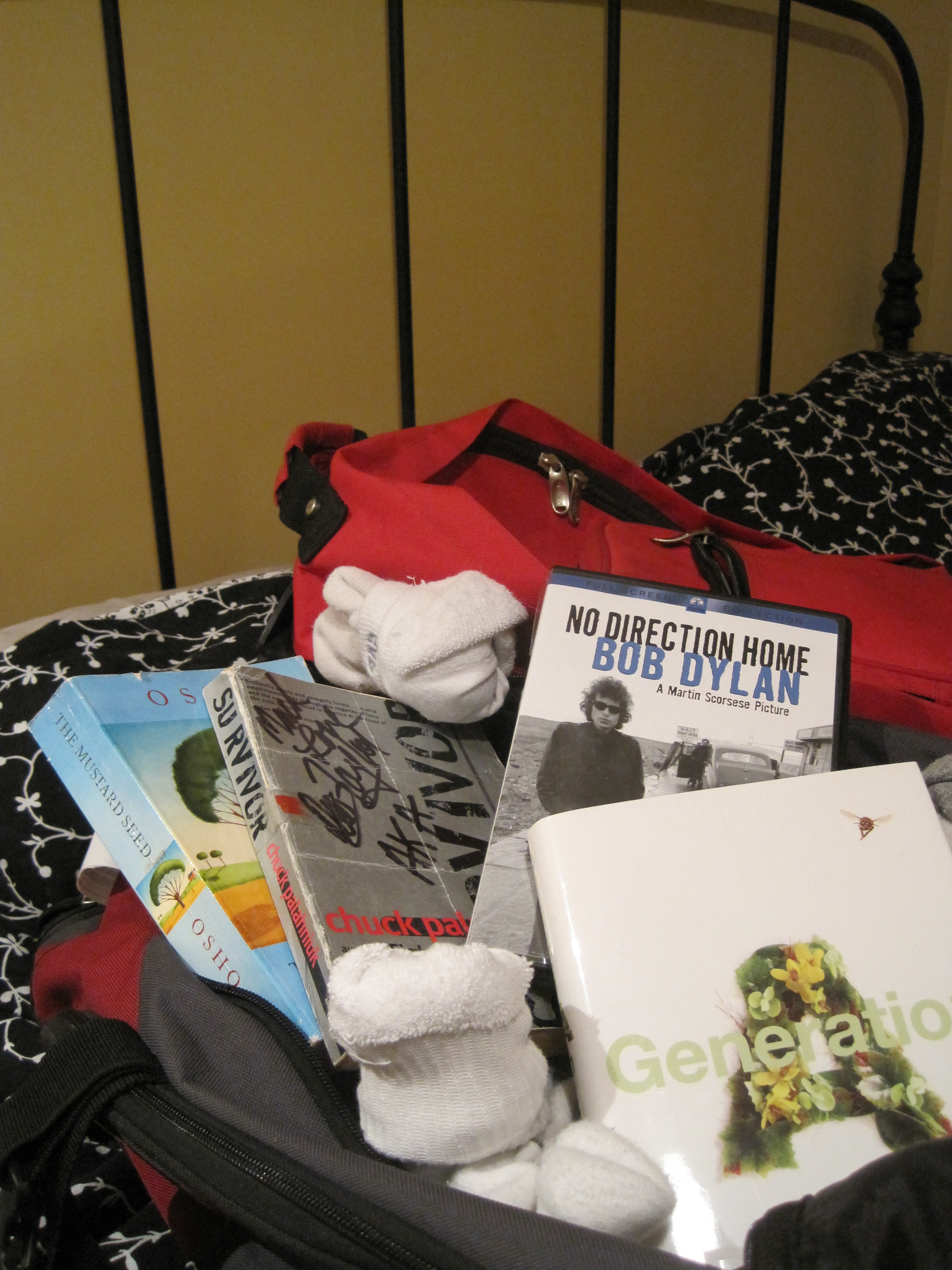
Why was I always surprised by what it was like being the mother of this boy, Hudson – this almost man?  I was driving him home from his second year at university.  The term was finally over and I knew it had its up and downs, and that Hudson’s attention and focus had sometimes ebbed.  But I saw first hand when I arrived to help him pack, that amongst his clothes, CDs and school texts, there were stacks of philosophy books, not required course material but books he’d picked up second-hand for pleasure reading because despite all resistance otherwise, he will always be a philosophical and reflective thinker who enjoys titles like Our Inner Ape, The Essence of Sufism, or On Being Free.

I was there staying with the relatives he boarded with during those last days and saw that he studied hard for his final two exams between the pull to visit a pub to say goodbye to friends he described as good guys, guys that he would miss.  He was more mysterious about the girl he needed to see one more time.

Hudson had said he was looking forward to our road trip home.  He even joked about it being a time to bond.  Yet the mood was sober when we set out. He’d written his last exam that morning and I heard relieve and satisfaction in his voice immediately after, as he embraced the relatives he’d lived with, and together we left to meet one of his friends from high school and her young husband for a goodbye lunch. At age nineteen and twenty-three respectively, they were expecting a baby in a month, and were both excited and scared about the unplanned path their lives were about to take.  Hugging his high school friend goodbye, her belly and the baby inside pressed against his own stomach, might have put the final touch of melancholy onto the mood he was in as we headed for the ferry.

We boarded a vessel two hours after reaching the terminal and consciously or not, spend most of the voyage apart, reading and watching the ocean waves on opposite ends of the ship.  We spend that night in Vancouver with Hudson’s big sister, Zoë, and her boyfriend, in a house full of boxes and spilled belongings, because they were also packing up and switching residences as they were both starting Masters programs in the fall.   They were thrilled to be making changes, but on that night they were weary and conversation was soft and slow in the dim, cluttered house.  Hudson and I left Vancouver for Calgary the next morning, under a steady spring rain and a dull sky. Driving through the dampness along the long, straight highway to Hope, listening to my son’s choice of music, I actually wondered if his mood had changed so much so that he had given up the idea of enjoying the trip.  A song came on that I particularly liked, Bowl of Oranges, “I like your music more these days,” I ventured.  “I liked what you were playing yesterday at the ferry terminal, too.”

Sounding exasperated, and only slightly amused at my musical ignorance, he told me, “That was the same song, Mom. It’s by Bright Eyes.  You always say you like Bright Eyes.”  We gassed up the Durango and wound our way to a coffee shop in Hope.  He ordered a yogurt, spinach salad and a water, while I justified my sugar and caffeinated choices of a brownie and cappuccino, as necessary for the road.

It was exiting from Hope where I took the wrong highway.  I realized it in time to go back and still could have made better time by returning to the road leading to the Coquihalla Pass over the mountains.  The wide, four lane surface would have taken us over the mountains in far less time.  So what made me stay on the longer, winding two lane highway that curled through the towns of Spuzzum, Boston Bar, and Spences Bridge?  My tired son wasn’t aware of my mistake and I took my time before I told him what I’d accidentally done.  He didn’t react except to ask if I wanted to listen to a Bob Dylan documentary on the car’s DVD player.  Sure, I said.  Hudson had discovered Bob Dylan in his first semester of university. He had been away from home for the first time, experiencing residence life which he disliked, and his first west coast dark and rainy winter.

I must have discovered Bob Dylan spiritually for the first time in my youth, too. Via cell phone conversations our absent son had turned his sixteen-year-old sister Lily, who was of course, at home with us, onto Bob Dylan at the same time he made his discovery, and she had been downloading and buying all his works so that our house had recently filled up with – “ if I don’t get the girl I’m loving I won’t go down Highway fifty-one no more”.  Lily set her CD alarm clock to wake her to Spanish Harlem Incident.  After school it was House of the Risin’ Sun,  It Ain’t Me Babe, and Like A Rolling Stone, and after she fell asleep at night I crept into her room to turn his crooning off.

A dappled sunlight broke through the clouds and the car crested the mountain top.  I saw a small sign beside the road that said, ‘Jackass Mountain summit.’  Hudson was singing along with Dylan. My kids don’t mind telling me that I can’t sing, but this time there was no comment when I joined him, “Look out the saints are comin’ through  And it’s all over now, Baby Blue.” The commentary continued, reviewers talking again about how Dylan resisted being pigeon holed, he didn’t like his songs to be considered protest songs.  Listening, I noticed as we sped down the road, how even that high up in the mountains the trees were in spring bud.

“Hey Hud, isn’t it something,” I said, thinking back to the night before listening to Zoë talk about applying for a teaching position while she did her Masters, “ Can you imagine walking into university class and having someone as young as Zoë for your teacher?”

“Yeah, I can.  I’ve always thought of Zoë as older.  She’s my big sister.”

It wasn’t the response I’d anticipated.  I’d hope to lead into a discussion about teaching being an option for Hudson.  He always saw through me, and blocked my thinly veiled suggestions as if he was still playing defense on his high school football team. “Look Mom, I can’t think about going back to school.  I know I’m not doing it this September.”  He was clearly a frustrated philosopher and I felt I ruined whatever easy mood the music had brought us toward.

We stopped to stretch, and buy chips, water, and a pack of gum at a gas station in Spences Bridge. As we were walking out Hudson nudged me,  “Weird, eh?  Listen.”  The gas station attendants were an old man and a teenage girl, and somewhere under the desk they had a radio on playing Bob Dylan’s A Hard Rain’s a Gonna Fall.  We stepped outside with an easiness between us again, talking about feeling goose bumps and what Dylan might think of the  synchronistic occurrence.

Leaving town one of my favourite songs was being sung now on the DVD, or maybe just the one most imbedded in my memory.  I sung out loud, though some of the words were guessed at or murmured.   The road ahead of us looked like it was heading off the globe, the pavement met the horizon, and it seemed the car could lift off there and glide into the blue sky.  “Isn’t it inspiring?” I asked over Dylan’s voice crooning, “I’m ready to go anywhere, I’m ready for to fade  Into my own parade, cast your dancing spell my way, I promise to go under it. Hey ! Mr Tambourine Man, play a song for me
I’m not sleepy and there is no place I’m going to
. I was worried about Hudson who wasn’t responding to my comment, unaware that he was  considering the surrounding steel, gray cliffs and deep valleys and a wide river way below us before he said, “Yeah Mom, it is beautiful, isn’t it?”

Lost Down Under

At times I think about those families that have nine or ten kids – or that television family with nineteen –and I wonder about the mothers.  Some people would surmise that they would worry less, because you just can’t worry that much, but worry, like love, multiplies, it doesn’t max out.  There are mornings when I wake up and take the tally of my four.  I’ll settle my mind on each of them and decide where they are on my crazy worry meter.

I think mothers of ten kids do a similar tally – it just keeps them in bed longer in the morning or awake further into the night.  Our second child, Cole, has been on my worry list often enough, but moved up to the numero uno spot when he decided to travel alone, circling half way around the globe to New Zealand.

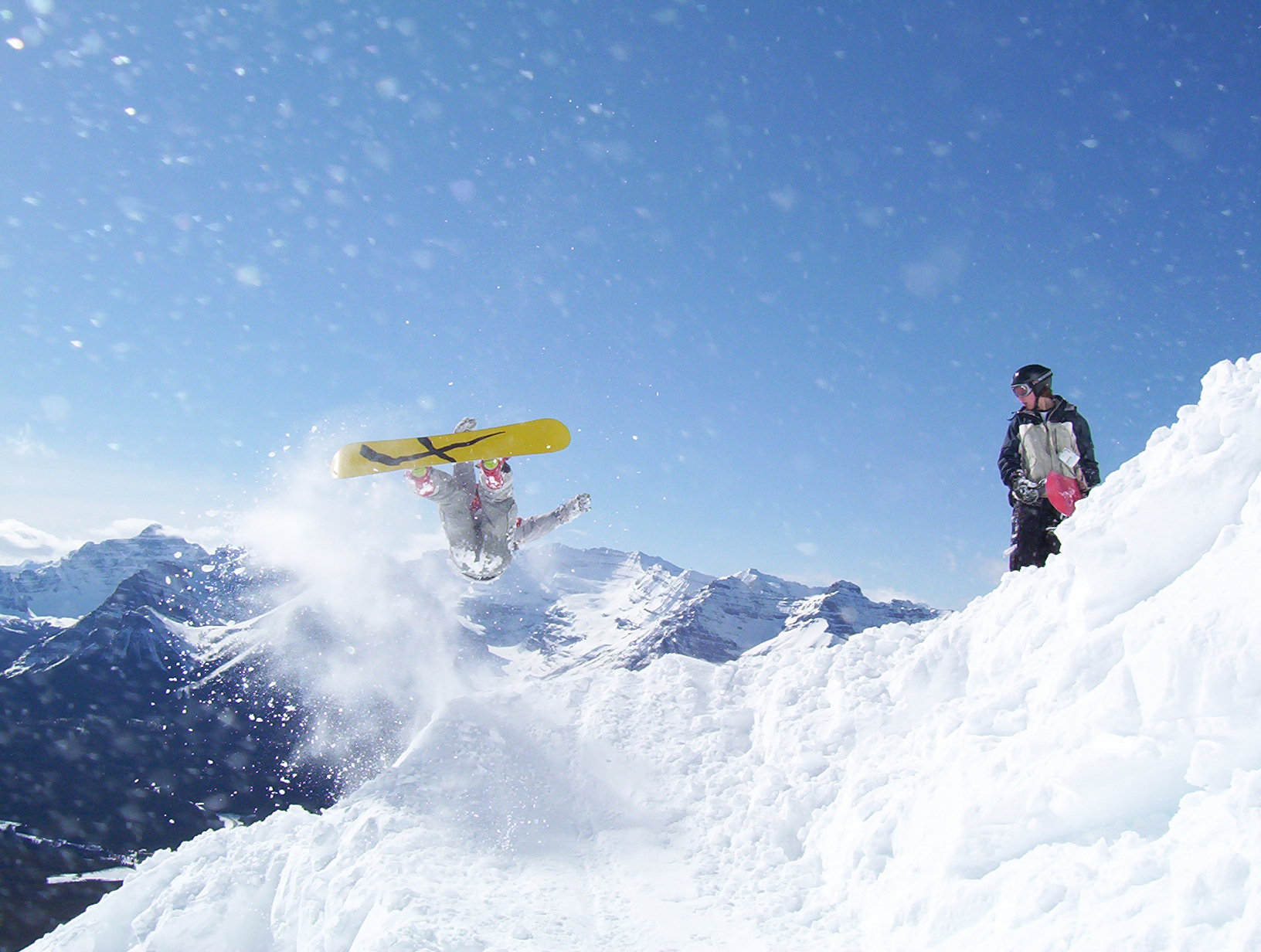
When Cole first left home at age eighteen, to have his bohemian snowboarder experience working as a lift operator in Whistler, B.C., he told us that staff meetings were held during which the kids were, according to my son, reminded to eat fruit or take vitamin C.  It was a true comfort that his employers were being mommy substitutes and taking some responsibility for the hundreds of young people, like Cole, working for the hill.  The resort also had a web site that I discovered  that listed rules and regulations for the resort staff as well as upcoming staff meetings.  When Cole first proposed his six month trip to New Zealand I wanted just such a web site.  Not quite twenty-year-olds traveling alone in New Zealand, it would say, must abide by these safety rules, and while on the job (of being a young traveler) should remember to eat their kiwi. Of course, in this fantasy of mine staff housing would be provided and someone would be in charge of my son’s experience.

Late one rainy afternoon, just as dusk was settling, Cole called home all the way from Down Under amazed that he had cell service because, he said, he was in the middle of nowhere trying to hitch a ride.  I could hear the echo of his heavy footsteps along the road.  Feeling the great distance between us with a heavy heart,  I begged him to please stop hitching, telling him  I’d lend him money to cover the bus fare.  He told me again that EVERYONE hitch hikes there.  It wasn’t like at home, he said.  There just weren’t buses.  He was chatty, which was unusual because despite his talkative nature in person, like so many guys, he just isn’t a phone talker, so I felt he was lonely for me, or family, or just company the way I was that dreary day.  I could hear the wind in his cell phone as he told me about the ridiculous distance he was trying to cover in an attempt to get to a job interview at a resort miles and miles and miles away.  I don’t know if it was dark where he was, but I imagined a gray sky as he asked, in a voice rising above the wind, how everyone was?  He started to tell me about the group of travelers he’d lived with and how New Zealanders eat pie, every type of pie; meat pie, fruit pie, vegetable pie, and right then we lost the connection.  Cole, I called into the phone, Cole… and I imagined him doing the same, Mom?  Mom?

I quickly called two friends to go for a therapeutic walk, but neither was home.  I called my husband and our daughter, Lily, but got both of their voicemail.  I tried hard to think of all the amazing things Cole had told me about New Zealand, how beautiful it was, how the people are as friendly as everyone has always said they were, how the place was full of Canadians like him traveling and boarding and eating pie.  I tried to imagine one of those pie eating, stupendously friendly people picking him up and fulfilling his need to chat.  But all I could think of, of course, was Cole standing on the highway having lost the connection to home.

That made me think of the time we lost him when he was just a little boy.  It had been a spring night, and not dreary at all, but rather clear and full of the promise of summer.  When I told six-year-old Cole that he could go meet his friends a few houses up the street on his bike, I was under the impression that it was far earlier then it actually was.

Suddenly the light coming into the house shifted from a reflection of dusk to nightfall, and I was alarmed to realize it was past eight and Cole hadn’t come in.  After shouting his name from the stoop and calling our neighbor’s homes, I became frantic screaming at my other three to help me, and then racing to the car and circling the nearest blocks, before phoning my sister and asking her if she thought I should call the police.

I dialed 911.  The operator wanted me to describe his clothing.  Panic was changing to hysteria and the 911 operator began to treat me like a woman on the edge.  She told me to stay in the house until the police arrived and in a strained voice I refused.  “I have to find my kid,” I said.  “I have to go find him.”   Rushing outside to meet the patrol cars I was shocked to see the street filled with people and cars and bicycles.  Without being asked the neighbors had organized a search.  People were knocking on doors, motorists and bicyclists were being sent to further points.  The description of a six-year-old blond boy in a jean jacket was being given to all who passed by.

The officers turned on their flashlights and sent me back into the house, “Look everywhere, places you’d think he’d never go, in every nook and cranny.”  The streets were ringing with Cole’s name.  I never stopped yelling it inside the house.

I don’t know what world he was in.  Why he was oblivious to all this? Obeying directions I took one more look in his room and found him, curled up tight, hidden under a pillow and a blanket, in a far, dark corner beneath his bed.  My insides stopped rattling, tears flowed down my cheeks, I reached for his sleeping body and tried to imagine how many people were now outside hunting for him.

Aside from deep gratitude I felt incredibly  embarrassed for several days, sticking close to home and assuming that despite people’s assurances otherwise, they really were all talking about that woman with four kids, and her husband always gone, and how she couldn’t even keep track of them.  Cole and I had a few important talks and more rules were laid down.

I vowed to keep better track of them, to pay more attention to what was going on around me.  I believe I  decided that for my own mental health what I needed to do was take them all into bed with me, eight-year old Zoë could bring her books and Hudson, just four then, could amuse us with his belly laugh giggles.  At two-years-old Lily’s favourite place was our bed anyway. The important idea was to keep my kids close for as long as I possibly could.  Their dad could bring us food and drink, like a protective bird bringing food to the nest.  So how did it happen, not so much later that I was in Calgary, same house, newer bed, and my second kid, the one who had caused me to want to keep them within hands reach, had left the bed, room, house, city, country and gone all the way down under to call me and lose our connection from a stretch of highway in New Zealand?  Where, oh where, did that put him on my worry meter?

A Place to Cry Outloud

Having our daughter Lily leave, at the age of sixteen, to live with an unknown family in Italy, as part of a foreign language immersion program was one of the biggest nest-departing challenges I’ve faced.  Lily had never minded checking in with me and sharing what was going on.  What I found hard to set boundries around was that when she told me details other kids would never divulge. I had a hard time not opening my mouth and attempting to guide her through her often impulsive, sovereign exploits.

Almost all of her contacts with home during her Italian Immersion program were through email.  What she discovered about her peers in Calgary at that age was that out of sight was almost out of mind.  As a result of that, I’d like to say I was treated to an almost daily email, but they were definitely not always a treat. At just barely sixteen, in such a unfamiliar situation, Lily needed guidance from me and her dad.  My headstrong daughter didn’t always agree.  Parenting loses a lot of its punch when you are a continent away from your child.  When you say, “hang out with your host instead of that stranger you met on the bridge,” and your honest daughter tells you she isn’t going to comply with your rules, it is hard to enforce consequences.

So we bickered via email, I was forced to make great strides in the art of the consoling email, and we gave each other a sense of the life we were separated from, zapping our words across countries and oceans.  Lily did tell me that she found a place to go to cry out loud – her preferred style of crying- and during those months she had reason to go there.  Her older sister, Zoë, and I had a friendly wager about whether or not our sensitive, finicky Lily would last the full five months without sobbing that we had to bring her home.  It was hard to determine the odds.

What the Little Brat Was Talking About

The sweet young women handling the interview for the Cultural Immersion organization asked our not-quite sixteen-year-old daughter, Lily, what sort of rules we have in our household.  This woman sitting in our living room with my husband, Lily and I, was here as part of the in-depth study of the prospective applicant, trying to determine if Lily had what it took to live with a host family abroad, immersed in a new language and culture for five months.

Back during the crazy hey-day of Lily’s older sister’s high school musical theatre involvement, when our home first became the place to congregate on a Friday or Saturday night (maybe Thursday and Sunday, too) there had been a time close to the opening night of Joseph and the Amazing Techno-Colored Dream Coat when I had felt the other kids were taking advantage of the largess of my willing to host them.  Better put, our place was turning into party central. One morning I woke up to evidence of underage drinking, along with the sight of two kids, one a girl with an extremely strict mother and the other a guy, who had crashed for the night in the same bed, albeit fully clothed.  Rules for our house were immediately posted on the basement door for the duration of the play.  Of all the rules that currently governed our home ie. inform me before you borrow my car, phone when you’re out super late,  we eat pizza on Friday ….Lily decided to reach back a few years, to one I’d posted on that basement door during the musical and tell the nice lady, “I can’t think of any. ..  Oh, I know a rule we have.  Boys and girls that aren’t related aren’t allowed to sleep together.”

After the crimson left our faces and we stuttered out some explanation for what the little brat was talking about, the interviewer indicated that it was a wrap.  The interview process was a safe guard against families that were really wacked out, she said, and ours was,  of course, fine.

“Hang on,” I wanted to shout, “this kid is too young, fussy, protected, small…” whatever they wanted to hear to stop the whole ridiculous plot.

Prego. They found Lily to be a well-rounded candidate and decided she could go to a little Italian village (little sounding safe).  Lily begged them to let her go to a city, urban girl that she was, and they complied, congratulating her on her being accepted to spend five months in Rome in an Italian language and cultural immersion program.   For five whole months she was to live in one of the loveliest areas, of the loveliest cities in the world – Trastevere –one of the last pockets of medieval Rome, in the home of a family who we had only exchanged a few brief emails with, people referred to by the organization involved as her host mom and dad.  Will and I had been replaced.

A Cacophony of Communication

At eighteen I embarked on a three month backpacking trip around Europe.  I made the brief echo-y phone call to my parents upon my arrival in France, to indicate that I had not disappeared over the Atlantic Ocean.  There were letters and postcard but no other spoken words for those ninety days. Perhaps those were the golden days of parent/child relationships and we’ve fallen back into a cacophony of communication.

Neither of my boys are overly communicative, still I like to think that they are within the normal range of same-age males when it comes to co-operating with their mother’s need for information and dialogue.  At age nineteen when Cole set off on his own trekking trip through parts of the United States, I would have lost less sleep and kept my blond hair blond, rather then tipping to gray, if we could have magically returned to those pre-cell days of my youth.

After a successful but uninspired term at university, Cole had taken another gap, that worrisome break in continuity. The afternoon he left for the U.S of A, his fourteen-year-old sister, Lily, and I were sitting outside in the warm autumn sun, commiserating on how great it seemed to be Cole just then.  He had just finished packing up his friend’s Chevy van.  His traveling companion, George, advised him to empty his suitcase’s contents into the drawers in his organized van, and leave the luggage behind.  The two boys posed while Lilly took photos of their departure, then they shooed her off and turned the van south towards the United States – the land they thought they knew through a thousand movies and every episode of The Simpsons.  They would take the number two south, entering the U.S at the Butes, Montana crossing and wind their way to Salt Lake City, Utah, where Cole wanted to purchase a real tight video camera.

Cole called on Halloween night, music blasting in the background.  He was getting sweet video footage on his new camera of a huge parade, though he confessed that earlier they had slipped down the wrong road in that unfamiliar city and things had looked sketchy.  I warned him to be careful about whose face he stuck that camera in.  And please do nothing sketchy, I didn’t want to hear about sketchy.

Hudson, only seventeen, but away at university, was even less inclined to ever call just to chat, but on that night he called to ask if we would be okay with him dropping two full term classes as he really didn’t like anything about them. Of course, we weren’t okay with it.  Also, he told us, his friend M from Calgary had moved out there unexpectedly, and the two of them were thinking of getting an apartment off campus.

On November first I received another call from Cole.  He told me that unfortunately things had got sketchy. George was not happy, wasn’t sleeping or feeling well, and just wanted to return home.  The boys, friends since forever, were trying to work out a solution. George agreed to drop Cole at whatever mountain destination he wanted to go to.

I was beginning to dread the phone calls.  Hudson called to ask me to send him his resume off our home computer as he was applying for a job, in case he dropped half his courses.  Replace the courses you don’t like with something you’re passionate about learning, I said.  I suspect my kids hate it when I start talking passion.

In the meantime George had dropped Cole off in Mammoth, California.   Cole loved it there – it reminded him of Whistler.  He’d met people from New Zealand and had gone skateboarding with some Americans.  And he said he met a nice Navajo guy who told him he got peyote for free because he was Navajo.  (These phone calls had me wondering just what kind of an out-of-body trip I might sink into with a little peyote myself.) And he met a woman on the street who said maybe he could live with her.  (What?)  He described her as old, and said he thought she was lonely.  I told him that seemed weird, and he should be suspicious.  He quoted me something about riding two horses at one time – you can’t ride Faith and Worry both – you have to ride Aware.  (Fine, I will ride Worry for him.)  He had been offered a job busing at a hotel restaurant and another job at a gym, as well as one at a skate shop, but all of them said he needed a visa.

Now I was making the phone calls.  Twenty-four hours later he had moved in with this older woman. Her house was pretty messy but they were cleaning it – he said it was his idea. (How messy, I asked?  Eccentric scary messy?) He said she had never discussed rent.  And she isn’t a cougar? Or pedophile? I asked.  No, he told me, I needed to chill out. She was just really, really nice.

The next day, jolted by early morning worries I called Cole to tell him he needed to tell me exactly where he was, what was this woman’s name?  He said her name was Annie and she lived near the Harry’s Donut Shop in Mammoth Lakes and drove a delivery truck.  Look Mom, I’m just trying to decide what to do here, he said. If he couldn’t get a job without a visa maybe he would go back to Whistler, in British Columbia, where he had heard there was already snow.

November seventh and Cole called to say he was in a car driven by a new buddy named Mosses (with Cole there is always a new buddy).  Cole had agreed to pay the gas to and from Whistler if Mosses would drive him there.  They were in a car which belonged to the sister of Cole’s Navajo friend.  He (the Navajo guy), not the sister, lent it to them.  They were close to Seattle.

An hour later – Cole called to say they had a problem – the police had stopped them – just to harass them he said, but they believed that when that happened Mosses put his wallet in his lap and then it fell out of the car six hundred miles back where they had stopped for gas.  Not having ID Mosses was now going to drop Cole at the border crossing closest to Vancouver.  Cole wanted his sister Zoë’s number to see if one of her friends in Vancouver could pick him up at the border (he had a lot of gear and his belongings in large plastic bags).

Another hour went by and Cole called to say they had reached the border but things weren’t good.  Mosses drove too far forward in his attempt to drop him off and had entered Canada accidentally.  Cole admitted to low balling the price of the video camera he bought in the States – just for a minute, he emphasized, before he saw they were going to be questioned thoroughly, but then both he and Mosses, the car and their bags, were being searched.  (Is this what I signed up for nineteen years ago?  To help my kid, looking like a bag person, lying (for only a minute, of course) get back into the country?)   Be polite and honest, I said.  Didn’t we tell you to be careful at the damn border?  They’re talking to me again, Mom.  Gotta go, Mom.  Gotta go.

An hour later Cole called again suggesting that maybe he better speak to dad.    They were trying to trip him up – they’d asked why he wasn’t with the person he drove into the States with (maybe George saw all of this coming). The horse shoe up Cole’s ass, as they say, and his people skills, were clearly not working for him.

I tried unsuccessfully to get Cole’s dad at work.  Cole informed me that his friend Brian’s dad, who lived in Vancouver, was driving to the border to pick him up. I was so, so grateful for Brian’s dad, whoever the hec he was, and glad Cole had the people skills he had, or this could have gotten far sketchier.

Another call from the other son – Hudson wanted to tell us he now had a job at a pizza place and that he wouldn’t be able to come home for reading break the following day as planned.  I assured him he could get another such job and told him that in case he decided he needed a break, I didn’t say – a break from  being seventeen-years-old and away for the first time, and overwhelmed by school work that should have been easy for you, and uncomfortable in residence –  in case he needed a break from all that, I wouldn’t cancel his plane ticket until the noon deadline the next day.

With all of the kids away but Lily, she got to be the target of my frustration.  In the time it took me to drive her to school while she ate her Cheerios and brushed her teeth in the car, (aiming I believe for yesterday’s spit spot out the window) I lectured her on how she would have no choice but to start university and finish it or not to bother going. As I let her out of the car, Hudson called to say the pizza place said he could start after reading break and yes, he would like to come home.  Cole called from Vancouver, where he had already been to the American Embassy to apply for a visa to work in Mammoth, California.  (Do they give visas to nineteen-year-olds when the job offer they want the visa for is in a skate shop?)

We picked Hudson up at 9:35 pm and talked about how he didn’t have to decide about what he would do in January just yet.  I cooked up a batch of sticky chicken wings for Lily and Hudson and he talked about his desire to maybe go to India or Tibet after he made some money in Calgary.  It had been a sketchy two weeks of connecting with the boys. Would it be easier if we weren’t linked by cell phones with updates on Californian cougars and borrowed cars entering the country illegally?  What sort of distressing phone call might I get from a kid in Tibet?

Frozen Toothpaste Spit

Mornings for our family of six were hugely chaotic when we were all younger.  I don’t miss the chaos, but rather all that energy.  My husband and I, and our daughter, Lily, developed a routine when the three older kids moved out.  Will left the house just before I had to haul Lily’s skinny butt out of bed, and Lily ate her cereal in the car while I drove her to school. After her Cheerio’s she brushed her teeth, and spat her toothpaste out the car window, ready (late) to do algebra with a fresh smile.

It was less organized when they were little kids, though there was a predictable rhythm to our chaos.  Will and I would lie in our warm bed, allowing the alarm to go into snooze mode.  “We’ve got to get up.  We’ve got to get up,” he always grumbled.   Motionless and on cue, there would be our little Hudson at the bedroom door.

“Is it a school day?” he would ask, wiping away the water rolling down his forehead from his saturated cow lick.  Back then Hudson was our morning child.   I would assure him that it was a school day, swinging on my bathrobe and plodding downstairs, without even splashing water over my squinched up face.  Cole would have hauled his quilt off the top bunk and hunkered down in front of the T.V.  I would go into automatic pilot – new day, same words.  “Cole TV off.  Clothes on, please.”  He’d roll off the couch and stagger into his room while I rushed off to  Zoë’s room.

“Come on, sweetie,” I’d urge, lifting the covers, and just as I would be about to give Zoë’s shoulders a gentle rocking, the veil of sleep would lift and she would get ready to join the din that was fast enveloping the house.  Cole, the son created in his father’s image, would be calling for me to find him socks, while his dad, who denies he’s ever made such a request, would be banging the dryer door and stomping about trying to locate the laundry basket.  My bladder would demand that I pay attention to it but there were not enough wheels rolling.  Everything had to be in motion before I could afford to pause.

Upstairs Hudson would already have a bowl of Cheerio’s.  My legs would circle like the Roadrunner’s as I located the socks for Will, who would be ready to make his exit, barefoot in his suit and tie.  (He’s not a breakfast eater or brown bagger.  Thank God.)  I’d lay Cole’s socks on the table and grab a cereal bowl just as Cole asked for a grapefruit.   My morning aerobic routine would move into full swing. Slice the grapefruit, spin and deliver.  Bend to the refrigerator for the ham and mustard. Long stretch to the top of the stairs, “Zoë, are you coming up?  You should be up here.”  Do the ham sandwich for Cole.  Count – one lunch down, two breakfasts, no kindergarten snack.  Zoë would come up, and I’d shove the Rice Krispees box in front of her.  With everyone in motion I’d race upstairs to use the bathroom, consider my disheveled state in the mirror for a split second, and run back down to the short order station to slap together a peanut butter and jam sandwich for Zoë’s lunch.

Ready before all of us, Hudson would suddenly be missing a school library book that he’d urgently tell me the teacher said he would have to pay for.  “What’s on the cover?” I’d ask and looking uncomfortably warm in his jacket, toque and mittens, waiting for the others at the door, he’d say, “A green pig maybe.”

“It’s under Lily’s bed,” Zoë would tell us.

“Don’t wake, Lily,” I’d warn Hudson, but of course he would and she would be down making some unreasonable demand on me, like a bit of food tossed her way for breakfast.

Hudson would request an apple for his kindergarten snack, instead of the orange I was about to pop into the pack he was already wearing on his back.  I’d take the stairs to the basement two at a time and find the apples were wrinkled, but would decide if I approached from the back I could get one into Hudson’s pack unseen, and throw in some cookies to compensate.

One of Cole’s friends often phoned to offer him a ride with his mother. Theirs was a two kid family – I’d attempt to hustle all of mine out together so they could stuff themselves into that neighbor’s compact car.  But then Cole would have lost a glove and someone else wouldn’t be able to locate her vinyl lunch bag, and on cue I’d say in an exasperated but determined voice, “I’ve had it.  This is crazy.  From now on you find all these things at night.”  Cole loved this particular pair of gloves so he would wear the one he had and put his other hand in his pocket.

“I hate taking paper.  It’s so wasteful.” Zoe would protest, long before paper became taboo.

“Bring it back and I promise to use it over and over and over again.”

By then Lily, would have joined our merry clan, asking for toast and jelly.  “Not now,” I’d tell her too abruptly, and she’d start to wail.

The neighbor would beep a friendly sort of ‘we’re here’ beep.  Zoë was usually last out, and always just about to pull her hat over a coiffure that looked like small animals had burrowed in it during the night, before I noticed and raced for the kitchen comb (once there were even kitchen toothpaste and toothbrushes in my endless attempts to do this better).  Keeping the door open with one foot and hoping I wasn’t exposing myself with my sloppy bathrobe, I’d tug the comb through her hair, one eye on the fully clothed and carefully groomed neighbor behind the wheel of the car she probably had time to heat up, before she loaded the dishes from her boy’s omelets into the dishwasher.

If the perfect neighbor weren’t picking them up they would all make it out to the steps and ask, “Can we walk?” – meaning do we have time? And I would say in a determined voice, “No, we have to change our ways,” and then urge them on with, “Now, run, run, run,” following up, in as calm a tone as I could muster, “Bye, have a good day,” because I felt strongly that something should be calm about their send off.   Still I’d have to direct them, “Go, go, you three,” like a shepherd, blocking off the stairways into the nether regions of the house, shooing them along.

I’d see that poor Lily had again been forced into self reliance and had made herself toast, dripping with blueberry jam, so I’d collapse on the couch, bundling her onto my lap for a bit of the one-on-one attention that we both craved, while I allowed her to feed me.

I did miss all that action years later – alone in the house, home from driving Lily to high school, lecturing her on being late and telling her that her toothpaste spit would still be frozen on the corner of Elbow Drive when she walked by on her way back home.  Weird – but I did miss it.

Gap or Gorge?

Two weeks shy of his eighteenth birthday our eldest son landed his dream job. Whistler Blackcomb resort had held their hiring fair in November, but warned potential staff that they wouldn’t actually be working until there was sufficient snow. After spending his meager savings on the flight west and accommodation while waiting desperately for snow, Cole found himself with the highly sought after position of liftie, or as he stated in subsequent resumes he was responsible for the safety and operation of the fastest upload capacity lift in North America. Our ecstatic boy was able to snowboard from the small apartment in staff housing that he shared with two strangers from Quebec, to his position at the chair lift, stationed at the top of the mountain.   He was so high up that he actually had cell service, nothing else was interfering with the signal up there, and he would occasionally call me before the first skiers showed up.  “Mom it’s sweet up here.  The sky is pink, seriously pink, and I can see over half a dozen mountains.  It’s cool.”

“Should you be on your phone?”

“No, but who would know?  When there’s no one coming up the lift it’s, I dunno know…lonely.  I mean, it’s just me.”

Cole called often in the beginning, justifying his need to make contact with some request, could I send Cd’s he left behind,  or he’d make an appeal for super warm gloves from a camping store.  Other times he would call and ask to speak to his brother, and eavesdropping I realized he was sharing the wilder aspects of being a liftie that I wasn’t privy too.   At the same time that he gained a few dozen new friends his cell service became less reliable.  I’d interrupt him trying seven-twenties in the snowboard park, his friends shouting in the background, or at a party any night of the week, a rapper rhyming nearby.  “Sorry Mom, I think I’m losing you,” he’d shout.

“Everything’s cool, Mom.  You’re breaking up,” he’d say and I was supposed to believe he was out of cell range when he lost me.

Yet as the winter carried on, working alone at the top of the mountain got lonelier, and the nights, in contrast, were perhaps too chaotic, if that were possible.  Cole came home in the early spring determined to save up for one more adventure.  His job, bussing tables at a popular bar on Calgary’s now famous Red Mile, was cut short by an Easter snowboard accident that left him with a cast on his arm and time to contemplate his new fascination with Buddhism.    Despite his Buddhist teachings he was distraught.  His year hadn’t gone as planned.  He had the itch to further his travels.  He wanted to be able to work despite the broken limb.  He suddenly ached to return to the freedom he’d known on the slopes of Whistler Blackcomb, which while not Belize, or remote Chili, represented a Mecca of sorts for him. It was there he’d first lived on his own, amongst a community of his peers, and there that he’d escaped the confines of his parents rules and learned to make a bean and rice wrap.

Never-the-less, with his one good hand he typed up the application to university in our hometown of Calgary.  We held our breath.  He talked more of Whistler, of the power of the sunrises over the peaks, of the new friendships forged.  Forward, we had whispered into his ear.  “Talk to your big sister Zoë.  Zoë loves being a student again.” (Of course, Zoë always liked being a student.)    “Try university.  Study whatever you think you’d like.  The boy/girl ratio is two to three.”  (We were desperate.)  “You did Whistler. You worked.  You broke your arm.”  Of course, all the while we wanted him to believe he was coming to the decision himself.

He sat in the sun on a summer’s day and chose courses – an eclectic array of mind expanding areas of study.  Still he wondered whether he shouldn’t take more time off, make the gap larger – let it turn into not a gap but a chasm, an abyss, a gorge … 

He thought the three day university orientation would be lame, but instead it was cool.  The way he went on to Hudson, who was beginning grade eleven, about the kids he knew and the tight barbeque and how he, Cole, (the guy who would switch from general studies to film production) got on an outdoor stage at some point and addressed his peers, you’d have thought I’d slipped him twenty bucks to influence Hudson to earn the marks to get there.

I drove Cole to his first day of university (how could I refuse?).  On the way up I told him I was proud of him for reaching this milestone.  “I guess,” he’d said, adjusting his hat.  He’d picked out his first day ensemble the night before. The look was casual with a hint of mystic – a 1940’s style gangster hat and 1970’s aviator classes, his dad’s  plaid shirt from some other decade, his brother’s jeans from this decade, and his very own new running shoes.

We pulled into the campus behind a line of cars driven by this generation of hovering parents.  I tried not to say too much.  Cole gave me a big grin before skateboarding away from me, asking directions from the first friendly looking girl he spotted on the fly by.  For a few minutes after he disappeared from view I let the car idle before driving off.  We’d done it.  We had made it through Cole’s gap year.  So why then couldn’t we trust our instincts when it was Hudson’s turn to have a gap, instead of leading him down the path to a trying experience?

To Gap or Not To Gap

Having had to sweet talk Cole, Hudson and Lily into beginning a university education I have come out strongly in favor of the gap year.  I remember reading about Royal Prince William’s gap.  He was taking a year off between completing his high school A levels and beginning his studies at Scotland’s St. Andrews University.  Prince William was going to fill his gap by; working on a UK farm, teaching English in a remote part of Chile, hunting on an African Safari, and trekking in Belize with the Welsh Guards.   Cole’s plans weren’t so lofty.

Of the many definitions for ‘gap’ in the Webster’s dictionary the most appropriate is – a break in continuity.  Cole’s father and I verbalized our support for the gap, desperate for it to lead our energetic son to decide with conviction, “Man, I want to go back to school.  I ‘m so down with getting on with my education.”  It seems there has to be a certain rhythm to the gap.  You want them to work hard at low paying jobs  – like the UK farm perhaps in Prince Williams case, but not spend too much of their earnings or time crowd surfing in mosh pits, drunk with freedom away from math homework and biology tests.

My father had feared the gap for his kids.  I graduated in 1977 from the same high school that Cole attended.  When I should have been studying for my own grade twelve final math exam, I had been stretched across my girlfriend’s bed listening to Elton John belt out Goodbye Yellow Brick Road and daydreaming about climbing the Eiffel Tower, and eating real Italian gelato –  as soon as our summer jobs had earned us enough to purchase; airfare, a youth hostel card, a Eu-rail pass, an awkward and heavy pack back, and the requisite pair of hiking boots.

Flying across the Atlantic Ocean I left the coziness of my parent’s house – where not only was there a meat and potatoes dinner on the table every evening, but my siblings and I had the luxury of cruising around to our friend’s homes in my dad’s Chrysler LeBaron.  Criss-crossing Europe I learned to stretch my food budget by eating a whole lot of bread and jam, and to decipher train schedules in a half dozen languages, all with little communication with any one at home – no texting for us.  Like a kazillion young Canadian (and Australian) kids, Cole’s dream was to spend a winter at a ski resort with a job on the mountain, living like a bohemian.  We were okay with that plan in a shaky parental-milestone way.

A university campus might have been a safer environment for the exploits of a barely eighteen-year-old boy intent on snowboarding through the winter with a pack of other hearty bohemian wannabe’s. (Three of my four kids graduated six months shy of being eighteen.  Warning – when thinking your chatty, obviously smart four-year-old is ready to start school – instead of calculating whether you want your little one to be the youngest one reading in grade one, figure out whether he should be the youngest drinking, smoking and asserting himself as a teenager in grade ten?)

While many of Cole’s friends were saving hard to travel to Thailand or Australia as their gap destination, Cole felt suitably wealthy with $900 in his bank account to set out for the Whistler Blackcomb resort to make his mark on the world.  With his room empty of his boarding gear, CD’s, guitar, and hacky sack collection, Cole was sitting on his duffel bag programming his new phone with a pensive look on his face.

“Do you feel kind of off- balance?” I had asked him.

“Shit Mom, yeah.  But why?  I’m so ready to do this.”  I told him that my dad had explained it to me years ago with an analogy.  We all have dens where we’ve matted down the grass and we’re comfortable in them.  Cole was leaving his den, and he didn’t have a new one yet. I told him Grandpa’s theory was that until he got comfortable in a new den and got the grass matted down there, he’d feel unsettled.  “Word, Mom,” he said.  “That’s good.  Yeah, I get that.”

Who would have guessed that the WestJet agent would be the guy to make me cry?  But here my oldest boy was, having just shaved off those hairs from his chin, that weren’t really whiskers yet.  The agent was explaining in a respectful, but detailed way; the gate location, baggage tags, and boarding time, aware that Cole, attempting to appear so casual wasn’t a seasoned traveler and was having trouble concentrating.  I blinked, and blinked, and blinked back tears.   It’s not that I don’t want them to grow up.  Growing up is okay, but watching my second child heading toward airport security didn’t make me feel at all secure.

I had launched another kid. I was stunned by how fast it had happened.  Cole was a small mammal looking for a den and for a while I would be that mother bear again.  I was going to lumber about in circles for a week or two, bewildered and confused, clinging to my cell phone and to the two younger kids left at home…

Stay tuned for  Thursdays blog – ‘Gap or Chasm?’